


Estabilizador de grava IBRAN: la elección del profesional.
Máxima capacidad portante y rapidez de colocación. Las rejillas para grava IBRAN®-X40 son la solución de referencia para todas las aplicaciones: entradas de vehículos, plazas de aparcamiento, viales de aproximación para vehículos de emergencia y cualquier otra superficie de grava estabilizada.
Obtenga una superficie firme y ordenada por la que puede circular cualquier tipo de vehículo. Fabricadas íntegramente con plástico 100% reciclado (PP+HDPE), estas rejillas mantienen sus propiedades en todas las condiciones climáticas sin volverse frágiles.
Con más de 100.000 instalaciones realizadas y más de 10 años de mejora continua, hemos perfeccionado nuestras rejillas de retención de grava. En ese tiempo incorporamos paredes de celda nervadas de 3,5 mm de espesor y una nueva base reticular moldeada en forma de X que impide la migración del árido hacia abajo a la vez que une la base de las paredes, evitando el colapso que se produce cuando una pared cede desde la parte inferior.
Combínelas con un geotextil desenrollable de instalación rápida, seleccionado según las características del terreno, para obtener el sistema antimigratorio de grava más eficaz del mercado.
El resultado es un sistema de malla de refuerzo de grava excepcionalmente eficaz, muy duradero y sencillo de instalar. Profesionales de todo el mundo las califican como las "mejores rejillas para grava de plástico que han utilizado jamás".
Para plazas de aparcamiento con grava, el sistema soporta las cargas por eje propias de una superficie rígida como el hormigón o el asfalto (25 toneladas por eje). Las rejillas IBRAN®-X40 mejoran el drenaje de la superficie de grava estabilizada, evacuando el agua de lluvia al terreno con rapidez y reduciendo las inundaciones superficiales.
Formato generoso (4 unidades por metro cuadrado, 500 x 500 x 40 mm) para una colocación rápida y sencilla, con un tamaño que minimiza los recortes y el desperdicio de material. Nuestro sistema de rejillas para entradas de vehículos hace que los proyectos de pavimento permeable sean rápidos y rentables, tanto en accesos residenciales como en aplicaciones comerciales de mayor envergadura. Correctamente instaladas, nuestras rejillas para grava están concebidas para durar.
Son la solución ecológica ideal para evitar la migración de la grava, incluso en pendientes de hasta el 25%.
- Totalmente drenante: solución eficaz de gestión de aguas pluviales conforme a los requisitos de pavimento permeable
- Cubre grandes superficies con rapidez (500 x 500 x 40 mm)
- Base reticular moldeada en X: retiene el árido y cierra la estructura celular bajo carga
- Estabiliza árido angular o decorativo de 5-35 mm
- Encaje a presión, interconexión rápida para una instalación ágil
- Apta para turismos, furgonetas, vehículos pesados y de emergencia con la subbase adecuada.
- Fabricada en Europa, en instalaciones IBRAN, con materiales 100% reciclados de alta calidad
- Resistente a los rayos UV y a las heladas (-50 ºC a +90 ºC)
- Accesible para sillas de ruedas, cumple los requisitos de accesibilidad universal aplicables
- Adecuada para una amplia gama de aplicaciones residenciales y comerciales, de uso ligero a pesado
- Garantía a largo plazo de 25 años (sujeta a instalación documentada; véase nuestra guía de instalación)
Especificaciones completas a continuación.
Estabilizadores de Grava Especificaciones
| Dimensiones: | 500mm x 500mm x 40mm |
| Cobertura: | 4 rejillas/m2 |
| Espesor de pared nervada: | 3.5mm |
| Color: | Negro (otros colores disponibles bajo pedido) |
| Celda interior: | 68mm x 68mm |
| Peso: | 860g/rejilla |
| Resistencia a compresión: | 500 toneladas por m² (ensayo PLT) |
| Carga por eje: | 25 toneladas |
| Material: | PP/HDPE 100% reciclado |
| Estabilidad térmica: | -50ºC a +90ºC |
| Árido recomendado: | Gravilla angular o decorativa de 5-35mm |
| Medioambiente: | No tóxico, químicamente inerte y reutilizable |
| Tolerancia de pendiente: | 25% / 15º |
| Conformidad: | Gestión de aguas pluviales y accesibilidad universal |
| Compatibilidad: | Apto para zonas arboladas |
Descargas técnicas
Acceda a más detalles técnicos y especificaciones mediante los siguientes enlaces:
IBRAN-X 40mm Ficha de datos técnicos
Comparativa de huella de carbono
IBRAN-X estabiliza la grava en cualquier tipo de obra.
IBRAN-X es el sistema de estabilizador de grava de plástico más versátil y resistente del mercado. Totalmente drenante y con una capacidad portante extraordinaria (500 toneladas/m²), es suficientemente robusto para cualquier entrada de grava económica, camino peatonal, camino de acceso o aparcamiento comercial e industrial.
Capacidad portante extraordinaria: hasta 500 toneladas por metro cuadrado.
Con un formato de 500mm x 500mm x 40mm, es posible cubrir hasta 360m2 por hora con un mínimo de recortes y esfuerzo. La estructura ligera (860 g por panel, con estabilizador UV y modificador de impacto) confiere a las rejillas una durabilidad excepcional. Además, se fabrican de forma sostenible en instalaciones IBRAN dentro de la UE, con materiales 100% reciclados de alta calidad.
Diseño cuidado, pensado para el profesional.
Durante los últimos 10 años hemos mejorado continuamente nuestro sistema de estabilización de grava, perfeccionando el diseño a partir de la experiencia directa de los profesionales. En este tiempo, IBRAN-X ha respaldado más de 100.000 proyectos. Los profesionales valoran IBRAN-X por:
- Instalación rápida: cubre grandes superficies con menos desperdicio de material en recortes.
- Encaje interconectable: proporciona solidez para el tráfico rodado, incluso en pendiente.
- Retícula en X: impide que el árido se escape por debajo y empuje las rejillas hacia arriba.
- Modificador de impacto: nuestra mezcla de polímero reciclado incorpora un aditivo que evita la rotura por impacto.
Instale en cualquier obra para crear aparcamientos accesibles para sillas de ruedas, caminos de acceso de uso intensivo, entradas de grava y caminos peatonales. Las rejillas para aparcamiento IBRAN hacen que la entrada de vehículos perfecta sea rápida y sencilla de ejecutar. IBRAN-X admite cualquier gravilla rugosa o lisa de 5 a 35mm, que se asienta perfectamente en las celdas de la rejilla.
Fabricación sostenible con polímero reciclado.
Superando los estándares del sector y concebido para el profesional, el diseño IBRAN-X integra todas las prestaciones que nuestros clientes han solicitado. Como fabricante comprometido con la sostenibilidad, nuestro objetivo es producir soluciones que rindan al más alto nivel, porque un producto que no cumple su función no es sostenible.
En coherencia con nuestros objetivos de sostenibilidad, las rejillas tienen el formato óptimo para una instalación ágil, sin necesidad de grandes recortes que generen residuos. Esto le ahorra dinero y reduce el impacto ambiental.
Calidad superior a precio competitivo.
Somos uno de los pocos fabricantes europeos de estabilizadores de grava con producción propia. No importamos ninguno de nuestros productos. Cada rejilla para grava de alta resistencia se fabrica en nuestras instalaciones y se expide directamente desde fábrica en un plazo de 1 a 4 días laborables tras superar nuestros controles de calidad.
Eliminar intermediarios innecesarios es lo que nos permite ofrecer estabilizadores de grava de primera calidad a un precio muy competitivo.
Instale las rejillas para aparcamiento IBRAN en cualquier emplazamiento para obtener una calidad duradera.
Miles de proyectos completados con éxito.
Podríamos darle cientos de razones para elegir IBRAN, pero creemos que la opinión de nuestros clientes dice más que cualquier argumento nuestro.
Con más de 10 años de experiencia y más de 100.000 proyectos completados, estamos seguros de que trabajar con nosotros le convencerá.
No se fíe solo de nuestra palabra. Lea lo que opinan nuestros clientes.
What is IBRAN-X?
IBRAN-X is a high-strength permeable paving grid system designed for gravel retention and ground reinforcement. Made from PP (polypropylene) and HDPE (high-density polyethylene), it creates stable, permeable surfaces for driveways, parking areas, and many other applications.
The unique cell design prevents gravel migration while allowing natural drainage.
Can you cut gravel grids?
Most plastic gravel grids can be cut to fit any shape or size of area, with the offcuts usually able to be recycled.
The larger the grid, the larger the offcuts can be. The smaller the grid, the more labour is involved in installing them - especially if they are interlocking grids. Our design sits in the sweet spot.
500mm square grids are considered the gold standard, and as such our grid is designed to this specification.
What are the benefits of using IBRAN-X?
IBRAN-X gravel grids offer multiple benefits:
- Exceptional strength (tested to 500 tonnes per square metre)
- 100% permeability for SuDS compliance
- Minimal maintenance requirements
- Rapid installation using our interlocking system
- UV stability to prevent degradation
- Eco-friendly construction using recycled materials
- Prevents gravel migration
- Eliminates rutting
- Creates wheelchair-friendly surfaces when properly installed
What vehicles can drive on IBRAN-X Gravel Grids?
IBRAN-X has been independently tested to withstand loads of up to 500 tonnes per square metre, making it suitable for everything from domestic vehicles to heavy goods vehicles.
This makes it ideal for:
- Residential driveways
- Commercial parking lots
- Emergency access routes
- Industrial applications
What kind of stone should be used with IBRAN-X?
For optimal performance, we recommend using 20mm angular gravel with IBRAN-X grids. However, the system can accommodate aggregates between 5mm and 35mm.
Angular gravel is preferred over rounded as it locks together better, creating a more stable surface.
For driveways specifically, 20mm angular gravel provides the best balance of stability and drainage while being less likely to get caught in tire treads.
How are IBRAN-X grids installed?
Installation follows these key steps:
- Excavate to the required depth (typically 150-300mm depending on application)
- Install a geotextile membrane to prevent upward migration of sub-base materials
- Add and compact Type 1 or Type 3 sub-base to the required depth
- Add a thin laying course of 10-20mm sharp sand or granite dust
- Lay IBRAN-X grids, connecting them using the interlocking system
- Fill with chosen aggregate
For detailed instructions, please consult our installation guide.
Is there a guarantee with IBRAN-X?
Yes - provided you can provide evidence of having followed our installation guide, then we offer a 25 year guarantee.
Is IBRAN-X Gravel Grids SuDS Compliant?
Our gravel grids are 100% permeable, making them one of the best Sustainable Urban Drainage Solutions.
Is IBRAN-X Wheelchair Friendly?
In the UK, there are no documents or set standards for approval of our system except for the government's own guidance, known as Part M.
To be part M compliant, the surfacing choice needs to demonstrably smooth enough to allow a wheelchair user to manoeuvre their wheelchair, whilst supporting their weight.
Using IBRAN gravel grids is the only way to make a gravel surface suitable wheelchair friendly.
This video demonstrates the ease of wheelchair use: demonstration video.
Is IBRAN ISO-9001 certified?
Yes, ISO-9001 is just one of the many certifications we are proud to carry as a manufacturer.
What are gravel stabilisation grids?
Gravel stabilisation grids are a type of ground reinforcement system made from PP (polypropylene) and HDPE (high-density polyethylene). They are used to create a stable, permeable, and aesthetically pleasing surface for a variety of applications, including driveways, walkways, and landscaping.
The grids are made up of a series of interlocking cells that hold the gravel in place, preventing it from shifting and moving underfoot.
What are the benefits of using gravel stabilisation grids?
There are many benefits to using gravel stabilisation grids, including:
- Stability: By preventing the gravel from spreading, they ensure a consistently stable and level surface
- Permeability: By allowing the passage of water, they reduce runoff, which reduces flooding in built-up areas by allowing for natural drainage
- Durability: The combination of PP and HDPE materials creates a robust system that is resistant to rot, decay, and pests
- Aesthetics: Gravel stabilisation grids can be used to create a variety of different patterns and designs
- Low maintenance: Once installed, gravel stabilisation grids require very little maintenance
Can I use gravel stabilisation grids on all types of ground?
Gravel stabilisation grids can be used on a variety of different ground types, including clay, sand, and gravel. However, it is crucial to ensure that the ground is properly prepared with a stable, compacted sub-base before installation. This foundation work is essential for the long-term performance of the system.
How long do gravel stabilisation grids last?
Gravel stabilisation grids made from PP and HDPE materials are extremely durable and can last for many years. However, the lifespan of the grid will depend on:
- The specific application
- The quality of installation and sub-base preparation
- The amount of traffic it receives
Do I need planning permission to install gravel stabilisation grids?
In most cases, you will not need planning permission to install gravel stabilisation grids. However, it is always best to check with your local planning authority to be sure.
How much do gravel stabilisation grids cost?
The cost of gravel stabilisation grids will vary depending on the size of the area you need to cover and the specific type of grid you choose. However, they are generally a cost-effective solution for creating a stable and durable gravel surface.
Additional Applications & Suggested Uses
Our versatile product can support a much wider range of applications.
Eco-friendly, sustainable grass and gravel paving and structural support solutions.
- Ground stability grids installed at ground level to prevent soil disruption from vehicle and foot traffic.
- Access roads and emergency service lanes (e.g., fire and ambulance routes)
- Driveway grids and gravel parking
- Grass or gravel car parks, including temporary and permanent overflow parking Reinforcement for residential driveways, lawns, and gravel parking
- Surface drainage solutions for stormwater management and flood control
- Safe water runoff solutions and French drains Stability for railway embankments
- Slope and embankment reinforcement
- Drainage and melioration ditches
- Use for horse paddocks, ménages, and arenas
- Buggy paths and disability access routes
- Golf course pathways and grass stabilisation
- School play areas and access routes
- Flooring for events and marquees
- Lawn protection for sloped gardens
What is the difference between a moulded mesh base and a heat-welded membrane?
A moulded mesh base is formed as part of the grid in a single moulding operation, so it is structurally integral to the cell walls. A heat-welded membrane is a separate sheet of fabric bonded to the underside of the grid after moulding.
The distinction matters for two reasons:
- Retention: a moulded mesh physically arrests downward migration of aggregate into the sub-base, and cannot delaminate or tear away, because it is the same piece of material as the grid.
- Structure: the mesh ties the base of every cell wall to its neighbours, resisting the tendency of cells to splay open under vertical load and under torsional loading from steering, braking and turning vehicles.
A bonded fabric contributes nothing to the structural performance of the grid. It is a filtration layer, not a reinforcement.
Does a heat-welded membrane stop gravel migrating downwards?
Only while it remains intact.
A thin non-woven fabric bonded to the underside of a grid will suppress weed growth and will initially hold back fines. The problem is where it sits: directly beneath the aggregate it is meant to retain.
Angular gravel is the aggregate specified for almost every stabilised gravel application, and angular gravel has sharp arrises. Under repeated point loading from vehicle traffic, those arrises work against a lightweight fabric until it is punctured. Once punctured, the membrane no longer performs the retention function and aggregate begins to migrate into the laying course and sub-base.
A moulded mesh base does not share this failure mode. It is rigid moulded polymer, not a fabric skin.
Does the mesh base do anything other than retain gravel?
Yes, and this is the part most specifiers overlook.
The cell walls of any gravel grid are, in effect, a honeycomb of thin vertical webs. Loaded vertically, and particularly loaded torsionally when a vehicle turns on the spot or brakes hard, those webs want to deflect outwards at their base. Once cells begin to splay, the grid loses its confining effect on the aggregate and the surface starts to rut and spread.
A moulded mesh base restrains the foot of every cell wall, holding the geometry closed and transferring load laterally across the panel rather than into individual webs.
Load performance and cell base design cannot be considered separately.
Do I still need a separate membrane if my grid has a mesh base?
We recommend using both. They are not doing the same job.
- The moulded mesh base retains aggregate and closes the cell structure, at surface level.
- A geotextile membrane laid at formation level, beneath the sub-base, prevents upward migration of subgrade fines into the granular layers and provides separation and, depending on grade, reinforcement.
Two different functions, at two different levels in the build-up. Combining a mesh-based grid with a correctly specified geotextile gives you retention at the surface and separation at formation.
Relying on a single bonded fabric to do both is a compromise driven by convenience rather than engineering.
Will a membrane-backed grid save me time on installation?
Marginally, and it is worth being honest about the scale of the saving.
Rolling out geotextile across a prepared formation is one of the quickest tasks in the entire installation. On a typical domestic driveway it is a matter of minutes.
Set that against the consequence of specifying the wrong separation layer, or of a bonded fabric failing in service. Excavating and relaying a failed driveway is measured in days and in thousands of pounds.
Choosing the membrane grade to suit the subgrade, the traffic and the drainage strategy is a decision worth making deliberately, at formation level, rather than having it made for you at the factory.
Why does IBRAN not bond a membrane to the underside of its grids?
Because it would substitute a consumable fabric for a structural feature.
Our grids are moulded with an integral mesh base that performs the retention function permanently and contributes to the load and torsional performance of the panel. Bonding a fabric on top of that would:
- Add cost
- Add a component with a shorter service life than the grid itself
- Remove the installer's ability to specify the right geotextile for the ground conditions they are actually dealing with
We would rather give you a grid that does not depend on a fabric, and let you choose the membrane the project needs.
Haili Branson
En líneaLa confianza de los líderes del sector


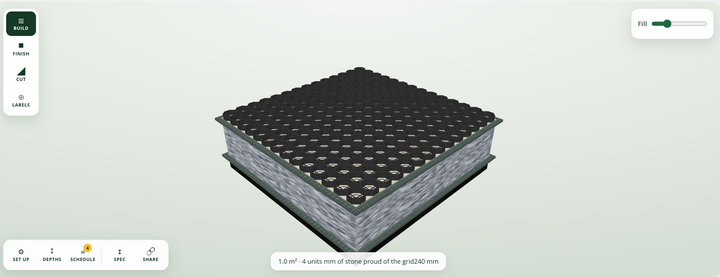
Diseña tu especificación técnica
Define la superficie, elige la rejilla y el árido de relleno, y visualiza el acabado final. Las cantidades y la especificación completa se generan automáticamente.
- Cantidades y pesos para el paquete de firme completo
- Profundidad de subbase por categoría de tráfico
- Añade las rejillas directamente a tu carrito

Por qué los estabilizadores de grava IBRAN son la elección inteligente para el profesional
Cuando tu nombre está en la obra, cada material que utilizas refleja tu nivel de exigencia. Por eso los profesionales de la construcción confían en IBRAN: nuestros estabilizadores de grava están diseñados para superar a las alternativas más voluminosas que prometen ahorrar tiempo pero que, en la práctica, no aguantan.
A diferencia de las rejillas sobredimensionadas con membrana incorporada, que ceden bajo carga y generan desperdicios con recortes incómodos y uniones frágiles, IBRAN ofrece una solución pensada para el profesional: rapidez de colocación, resistencia estructural y cero concesiones:
- Formato compacto y modular para una manipulación más ágil, corte más sencillo y menos residuo en obra. Sin forcejear con paneles de 2 m ni tirar tiras sobrantes: cobertura eficiente sin plástico de más.
- La base de malla cruzada retiene la grava en su sitio, impidiendo la migración del árido por debajo y eliminando el levantamiento superficial, algo que las membranas no pueden garantizar una vez perforadas por el árido o asentadas de forma irregular.
- Polipropileno 100% reciclado con modificadores de impacto: resiste la fisuración, la rotura y la fragilidad por bajas temperaturas, con una durabilidad muy superior a la de las celdas en panal de paredes finas y textiles no estructurales.
- Encaje a presión desde arriba para una instalación rápida: cubre cientos de metros cuadrados por hora, en solitario o en equipo, con enclavamiento inmediato y preparación mínima.
- Totalmente compatible con los remates perimetrales y accesorios IBRAN, para pasar de la preparación al acabado sin esperas, improvisaciones ni sistemas incompatibles.
Las rejillas IBRAN no están sobrediseñadas para aparentar: están construidas con inteligencia para que instales más rápido, consigas acabados más precisos y reduzcas las intervenciones posteriores. Y como no hay ninguna membrana frágil cosida a la base, lo que colocas se queda donde debe.
Instálalo una vez. Sin flexiones, sin complicaciones, sin fallos.
Soluciones sostenibles
Los estabilizadores de grava IBRAN combinan facilidad de instalación y versatilidad con un sólido compromiso medioambiental. Fabricados en la UE en instalaciones propias de IBRAN a partir de polímeros 100% reciclados, contribuyen a reducir la huella de carbono tanto en la producción como en el transporte, inmovilizando residuos plásticos de forma permanente en cada metro cuadrado instalado.
Otras ventajas destacadas:
Control de la erosión: Al estabilizar la explanada, los estabilizadores de grava frenan la erosión provocada por lluvias intensas, protegiendo la vegetación y el entorno.
Gestión de aguas pluviales: La estructura permeable permite la infiltración del agua de lluvia a través de la superficie, reduciendo el riesgo de inundaciones y erosión.
Reducción del efecto isla de calor: A diferencia de los pavimentos impermeables convencionales, los estabilizadores de grava contribuyen a bajar la temperatura superficial y a crear entornos más frescos.


Instalación sencilla
Los estabilizadores de grava IBRAN son fáciles de instalar. Las capas porosas se interconectan sin esfuerzo para retener todo tipo de áridos (10 - 30mm). Se pueden colocar sobre cualquier superficie nivelada, incluso con pendientes de hasta el 25%.
- Coloca las rejillas sobre una subbase bien compactada y nivelada.
- Extiende una capa de asiento de arena de machaqueo sobre la subbase, cubierta con geotextil permeable.
- Encaja las rejillas entre sí y rellena con árido a granel.
Esta combinación mantiene tanto las rejillas como la grava en su posición, creando una superficie sólida y sin roderas apta para el tráfico rodado.
Con un mantenimiento mínimo, los estabilizadores de grava IBRAN tienen una vida útil superior a 25 años.


